

The Accommodation Is Real. The System Has No Way to Deliver It.
IEP delivery failure, complaint-driven enforcement, and a compliance model that documents transmission rather than ensuring it.

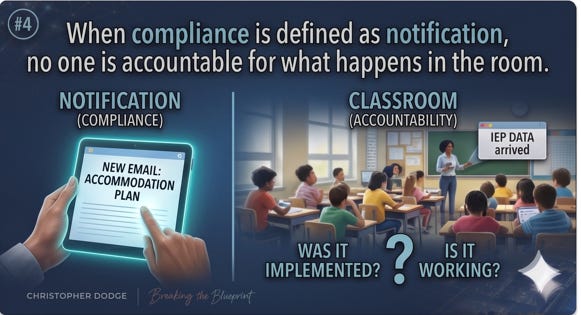
Three teachers received the same document on the same September morning.
One page. A student’s name.
A disability classification.
Six accommodations — extended time, preferential seating, chunked assignments, among them.
The email came from me, with the subject line “IEP Accommodations — [Student Name] — Confidential.” All three teachers opened it. Opening it marked the point at which compliance could be demonstrated.
By November, that student had been tested without extended time twice, seated in the back row of one class, and given a shortened assignment — not chunked, just shorter, which is a different thing.
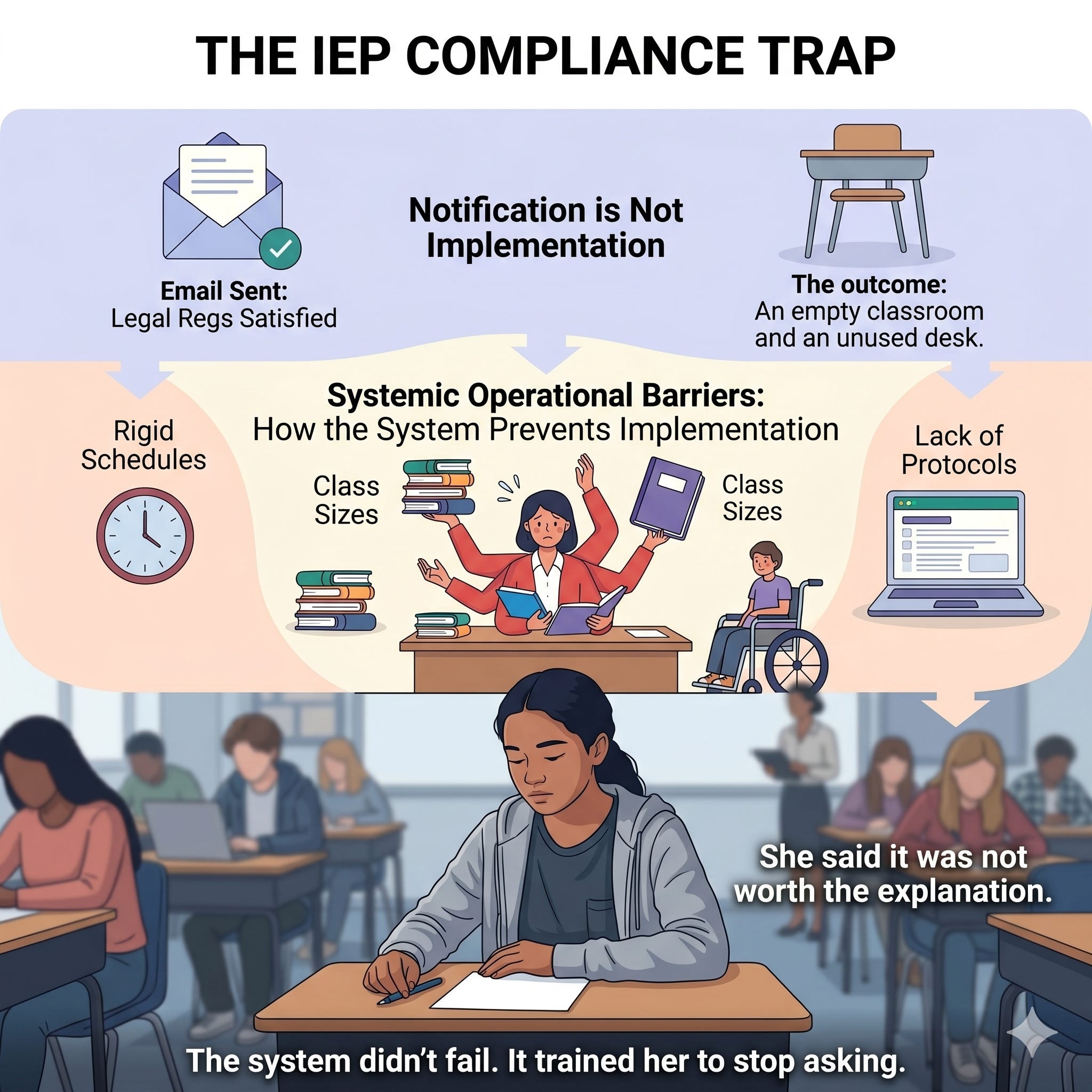
I knew this because the student told me. She had stopped asking teachers to honor the accommodations midway through the semester. When I asked why, she said it was not worth the explanation.
That is not a failure of delivery. That is the system producing its predictable output.
The accommodation is legal. The delivery mechanism is an email. That is not a gap in the design — it is the design.
Federal regulation requires that teachers be informed of their responsibilities (34 C.F.R. § 300.323(d)). It does not require understanding, demonstration, or verification.
An email satisfies the requirement.
Whether the accommodation is implemented is operationally separate and largely unmonitored because enforcement is complaint-driven rather than routine.
The compliance model documents transmission. It does not ensure delivery.
The gen-ed teacher who put the student in the back row had thirty-one other students and a seating chart that predated the IEP meeting. The one who gave a shortened assignment instead of chunked material had been told what to do, but not how to do it differently. The one who ran the test without extended time had a fifty-minute period, a prep bell, and no protocol for what happens when one student needs more time and twenty-seven others don’t.
These are not excuses.
Staffing models, schedules, and class sizes produced these conditions, and the system has no routine mechanism to detect when they prevent implementation.
What would delivery actually require?
A case manager with authority to adjust classroom practice, not just describe the expectation. Planning time blocked for accommodation review, not just notification. A schedule built around what extended time logistically demands — a second testing space, a paraprofessional, a protocol.
An administrator who asks during the October walkthrough whether what she observes matches the documented accommodations.
None of these is conceptually complicated. All of them require moving something that currently exists: master schedules, prep contractuals, staffing ratios.
That is why they don’t exist — not because no one thought of them, but because implementing them is operationally expensive in ways the current compliance model does not require any actor in the system to pay.
The student I described passed the course. She also learned, before the end of eighth grade, that the accommodations written in her name were not worth the explanation.
The system did not just fail to deliver the accommodations. It trained her to stop asking for them.
That consequence does not appear in any compliance record, because compliance was never designed to capture it.
The email was sent.
The teachers were informed.
The requirement was met.
Any reform that responds to this by adding more documentation is working on a problem the system has already declared solved — and does so without requiring any redistribution of time, authority, or resources.
When compliance is defined as notification, no one is accountable for what happens in the room.
References
34 C.F.R. § 300.323(d) (2006). Individuals with Disabilities Education Act.